


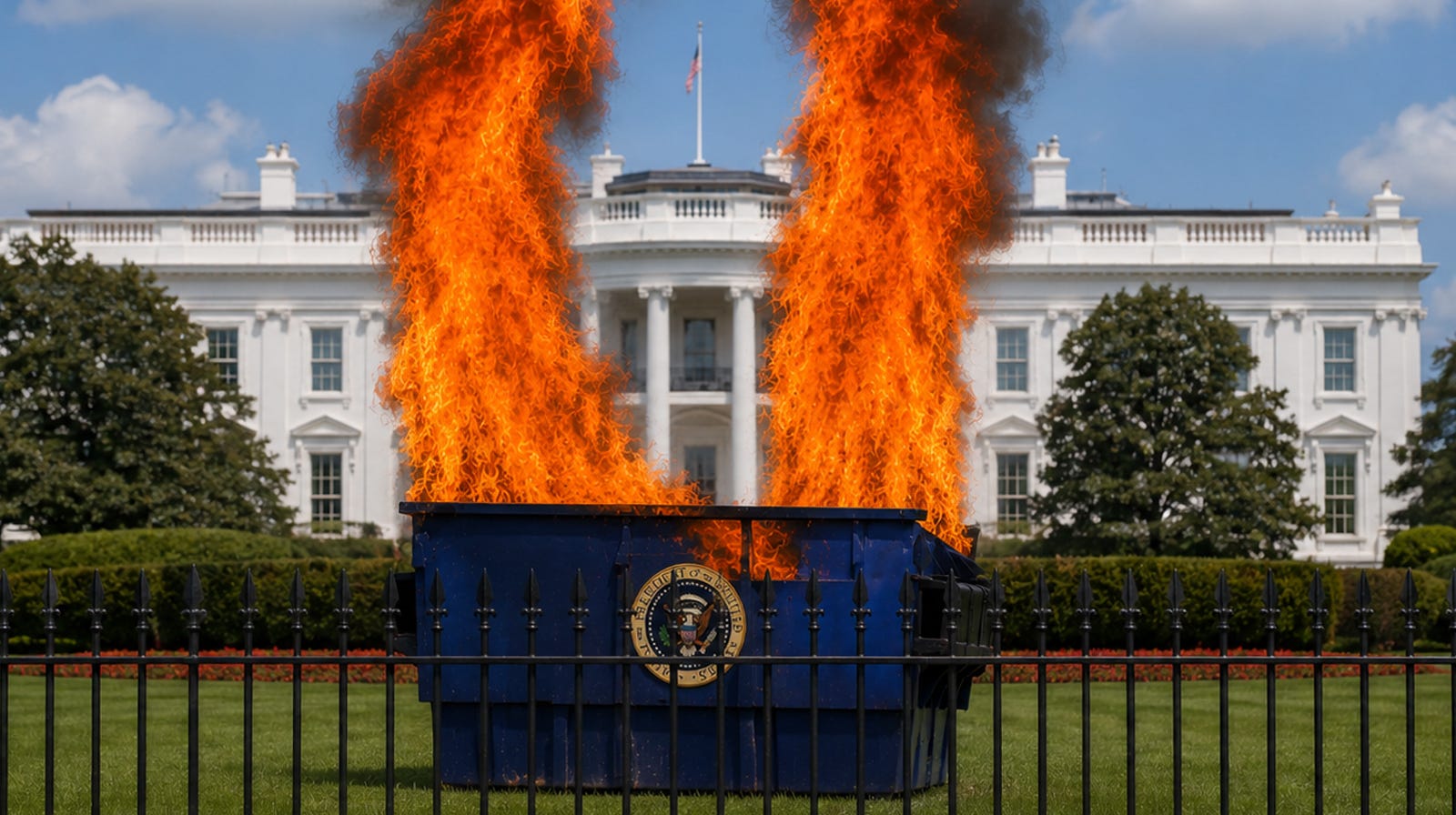
Donald Trump announced a deal to end the U.S. war with Iran, then went off to preside over the “garish public spectacle” he arranged for his birthday on the White House South Lawn.
The celebration was the tell. Even before the full terms were public, the broad shape of what followed looked less like victory than a rushed exit from a war Trump chose, sold with chest-thumping promises, and failed to finish.
Trump’s own messaging gave away the scam. He framed the agreement as a triumph that would “open” the Strait of Hormuz and restore global oil flows, as if that were some generous gift from Washington rather than the reversal of chaos his war triggered.
He also claimed the deal would mean Iran “can never have a nuclear weapon,” a line he repeated as the central justification for the war.
Reality reads differently in the reporting. The framework is expected to be signed in Geneva, and it sets up a 60-day period of further talks, with Iran’s nuclear program still a subject for negotiation.
The paperwork is thin, and the nuclear question is still not settled
ABC News and other media outlets described the proposed arrangement as a “memorandum of understanding,” not a final peace, and said a senior administration official estimated an 80 to 85 percent chance a deal would be signed in the coming days.
That same official claimed the framework would reopen the Strait of Hormuz and lift the U.S. blockade, while asserting it “leads to the dismantling of Iran’s nuclear program” and the U.S. taking and destroying enriched material. ABC also reported there were “no specifics” about how any of that would happen.
The New York Times put the gap even more bluntly. Trump publicly declared victory, but the agreement “leaves that issue unresolved for at least another 60 days,” as both sides negotiate nuclear issues. The Times also reported Iranian negotiators have held firm on not giving up the right to enrich uranium, which is the core dispute that war did not magically erase.
The Guardian’s analysis argued the compromise deal could land the parties back at “almost exactly the same point” as the Geneva talks that were underway before the bombing started, with the same questions still on the table.

The strongman storyline collapsed under its own propaganda
Trump launched this war with maximalist promises, annihilating Iran’s capabilities, abolishing nuclear ambitions, toppling the theocratic leadership, and even encouraging Iranians to seize their government.
He also insisted the only acceptable path was “unconditional surrender.” The Atlantic notes those goals were not achieved, and the U.S. is now racing to “sign, seal, and deliver” what it calls America’s capitulation.
Trump’s favorite tactic is to substitute performance for power. He posted that he “authorized the toll free opening” of Hormuz, but The Atlantic argues that claim has no real force because only Iran can decide whether the strait is safe and passable.
The Times similarly described Trump’s victory lap as “solving a problem of his own making,” after he miscalculated Iran’s ability to choke the strait and rattle the global economy.
The Guardian adds that shipping and insurance companies will decide when oil “begins to flow,” not Trump’s social-media declarations.
That mismatch between branding and reality matters because it signals weakness to Iran, to allies, and to everyone watching Washington talk big and then bargain from a worse position.
Seven humiliations that add up to one defeat
Failure 1:
Trump’s deal is shaping up worse than the Obama agreement he trashed. Trump’s brag, Iran “will promise never to build or obtain a nuclear weapon,” is not new, since that pledge was in the first paragraph of the Obama-era nuclear deal Trump tore up.
Tehran had already pledged under the JCPOA not to seek nuclear weapons, and the deal seemed to be working before Trump unilaterally canceled it.
The NY Times quotes Daniel B. Shapiro warning Iran can drag out negotiations and “pocket concessions,” adding it is “very likely” any deal reached now “will be worse than what we could have achieved through diplomacy before the war.”
Failure 2:
Americans paid the price in blood and credibility. News reports indicate the war killed thousands of Iranian civilians and 13 American service members.
U.S. power and credibility were “undermined decisively” in front of the world. And, the nation is left weaker with depleted weapons stocks and consumers paying at the gas pump.
Failure 3:
Iran stands to get sanctions relief and frozen money. Media outlets reported the deal could include relief from U.S. sanctions and $24 billion in frozen Iranian assets.
The Guardian also flagged uncertainty about whether that $24 billion gets released before or during the intended nuclear talks. Reportedly, Iran gets $12 billion on Friday or it won’t sign the memorandum.
⭐ So glad you’re here today. Subscribe, free or paid, to help keep my work independent, fearless, and open to all. ⭐
Failure 4:
Hormuz became Iran’s leverage, not Trump’s trophy. Tehran has been bolstered by its proven capacity to close the strait and squeeze the global economy, and experts say the terrorist state will never relinquish control over that passageway.
The strait remains under threat of Iranian attacks, regardless of Trump’s announcements.
Additionally, Trump’s claim Iran won’t be charging a toll for passage isn’t the full story. News outlets point out that would be illegal under international law. So, Iran reportedly plans to charge a service fee.
Failure 5:
Israel is sidelined, and Netanyahu is publicly humiliated. The Atlantic reports Trump grew angry at Benjamin Netanyahu for complicating the U.S. exit, including a call where Trump swore at him and said, “You’d be in prison if it weren’t for me.”
The Guardian calls freezing the battlefield a “political disaster” for Netanyahu, since Iran, Hezbollah, and Hamas are “all still standing” while Israel’s relationship with the U.S. takes a battering.
Failure 6:
Regime change never happened, and the regime survived the onslaught. Iran’s leadership has been “emboldened” and withstood pressure, even as Trump’s early timeline of “four to five weeks” collapsed into months.
The Atlantic says the war closes with the regime intact and under the grip of the Islamic Revolutionary Guard Corps.
Failure 7:
Iran keeps the tools of coercion. Iran will continue to possess significant drone and missile stocks, maintain the capability to be a state sponsor of terror, and keeps control over the Strait of Hormuz.
Trump’s ending is a lose-lose, and he wrote both options
Trump’s team can keep insisting the framework creates “leverage,” but the reporting shows the hardest part, Iran’s nuclear program, is still unresolved and deferred into another negotiation window.
The unsigned interim deal includes “no detailed parameters for future nuclear negotiations,” while Iran arrives knowing “it was Trump who blinked first.”
The Atlantic warns Iran has incentives to sprint toward a bomb with less transparency than the JCPOA required, and it mocks the fantasy that the U.S. can simply march in and remove enriched material without Tehran’s consent.
Trump now sits with two bad outcomes. One outcome is a shaky agreement that restores a prewar status quo on shipping while leaving the nuclear dispute alive, handing Iran relief and legitimacy while Trump declares victory anyway.
Another outcome is renewed conflict that Trump says he could restart, even as The Atlantic argues markets and voters have soured on the war, making the threat ring hollow.
Either way, the myth of MAGA competence collides with the same fact, Trump picked the fight, promised the impossible, and ended up negotiating from a weaker place.
⭐ Feel free to share this post. My articles are never paywalled, because the truth should travel freely. ⭐
What about the 300 billion that Iran could access? I didn't see any mention of that in the article.
Why is Iran a terrorist state?