


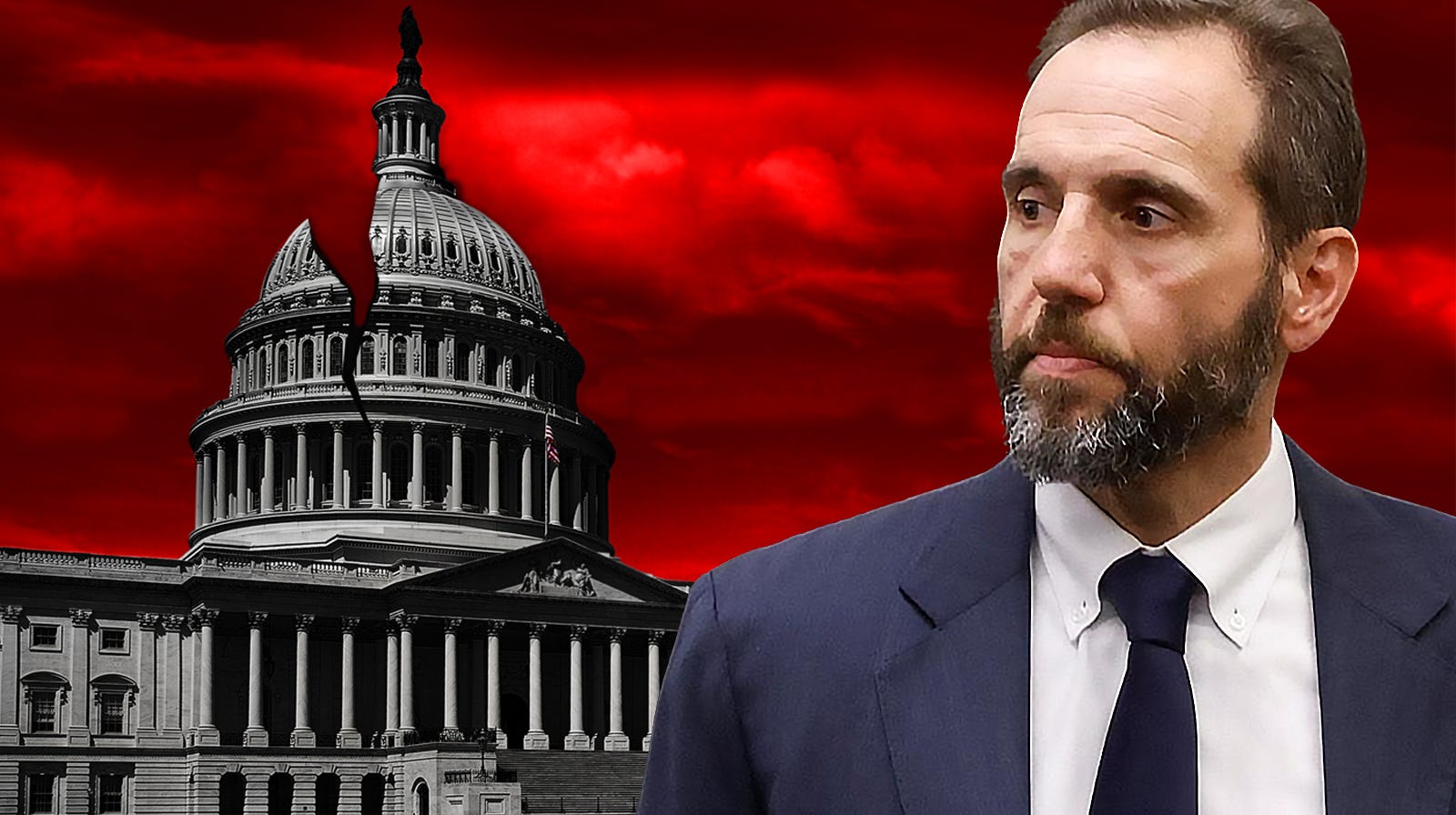
The House Judiciary Committee went hunting for a soundbite to justify Donald Trump’s retribution tour. Instead, they got a lecture on the rule of law from a war crimes prosecutor who refused to blink.
House Judiciary Chairman Jim Jordan likely envisioned a different outcome when he subpoenaed Jack Smith.
The goal was transparent: drag the former Special Counsel behind closed doors, away from the cameras, and badger him into a misstep that could be leaked to friendly media outlets as proof of a “weaponized” Justice Department.
It was supposed to be the final nail in the coffin of the federal investigations into Donald Trump - a performance designed to validate the narrative that Smith was a partisan hack.
That strategy spectacularly backfired.
The transcript of the December 17, 2025, deposition, released on New Year’s Eve, does not show a broken bureaucrat apologizing for overreach. It reveals a seasoned prosecutor delivering a masterclass in evidentiary rigor.
Smith, whose career spans nearly 30 years from local district attorney offices to the International Criminal Court at The Hague, used the Republicans’ own forum to read Trump’s crimes into the permanent congressional record.
“The decision to bring charges against President Trump was mine, but the basis for those charges rests entirely with President Trump and his actions,” Smith told the committee in his opening statement.
It was the first of many devastating rebukes Smith delivered during the nearly eight-hour proceeding, systematically dismantling the GOP’s grievance narrative with the one weapon they couldn’t confiscate: the truth.

The “Problem” of Overwhelming Evidence
Republicans spent much of the hearing attempting to portray the investigation as a desperate search for a crime. Smith corrected them with a cold, hard reality: his problem wasn’t finding evidence; it was managing the flood of it.
When pressed on the strength of his case, Smith didn’t hesitate. “We had proof beyond a reasonable doubt,” he declared, referring to both the election interference and classified documents cases.
The most stunning revelation came when Smith discussed his trial strategy. Far from scraping the bottom of the barrel for witnesses, Smith revealed that he had so much incriminating testimony he had to make strategic cuts.
“This was not a case where we needed more witnesses,” Smith explained to the committee. “It was a case where we needed to be able to present the case in a streamlined way because there was so much evidence.”
He detailed how he planned to rely not on Democrats, but on the very Republicans Trump appointed. “The evidence that I felt was most powerful was the evidence that came from people in his own party who... put country before party,” Smith testified.
Smith cited former Vice President Mike Pence and Republican state officials who refused to break the law, noting that their testimony “would have had great weight and great credibility with a jury.”
Smith made it clear: the witnesses who would have testified against Trump were people who wanted him to win.
⭐⭐Join the resistance. Subscribe for more fearless commentary. Your support keeps this space open and ad-free.⭐⭐
The “Affinity Fraud” of the 2020 Election
Smith provided a new, piercing framework for understanding the January 6 conspiracy. He didn’t just call it a lie; he defined it as a calculated exploitation of trust.
“In a lot of ways this case was an affinity fraud,” Smith told the lawmakers. He compared the President’s actions to a financial scammer who targets a specific community, exploiting their faith to rob them blind.
"When someone commits an affinity fraud, where you try to gain someone's trust... and then you rip them off, you defraud them," Smith explained.
He applied this directly to Trump's conduct: "The President had people who he had built up... trust in him, including people in his own party, and he preyed on that."
This characterization strips away the “political speech” defense.
Smith argued that while the First Amendment protects lying, it does not protect fraud used to obstruct a government function. “Fraud is not protected by the First Amendment,” Smith lectured the committee lawyers.
Smith laid out how Trump was repeatedly informed by his own inner circle that his claims were baseless, yet continued to push them to incite anger.
Smith’s testimony regarding the violence of January 6 was equally unsparing. He rejected the revisionist history of a “peaceful protest,” reminding the committee that “over 140 heroic law enforcement officers were assaulted.”
He drew a direct line between Trump’s rhetoric and the danger to the Vice President, stating that Trump’s tweet attacking Pence during the riot “without question... exacerbated the danger to his life.”

“A Ballroom and a Bathroom”
While the election case was about fraud, the classified documents case was about a reckless disregard for national security.
Smith refused to let the committee gloss over the physical reality of where America’s most sensitive secrets were kept. He bluntly described the scene at Mar-a-Lago:
“President Trump willfully retained highly classified documents after he left office... storing them at his social club, including in a ballroom and a bathroom.”
Smith dismantled the “raid” narrative regarding the FBI’s search of Mar-a-Lago by walking the committee through the timeline of obstruction.
He described a “shell game” where Trump directed his aide, Walt Nauta, to move boxes to hide them from Trump’s own attorney.
“Nauta, at Trump’s direction, moved 64 boxes from the storage room to the residence,” Smith testified, noting that only 30 boxes were returned before the lawyer conducted his search.
This wasn’t a bureaucratic dispute; it was a criminal effort to deceive the government.
Exposing the Hypocrisy of “Weaponization”
The irony of the hearing was palpable. GOP members accused Smith of weaponizing the justice system while simultaneously justifying the Trump administration’s purge of the DOJ.
Smith didn’t let this slide. He called out the administration’s attacks on career civil servants - FBI agents and prosecutors - who have been fired simply for doing their jobs. “These dedicated public servants are the best of us, and they have been wrongly vilified,” Smith said.
He also highlighted the personal cost of the “retribution” campaign. Smith confirmed that Trump issued an Executive Order targeting Smith’s private law firm, Covington & Burling, stripping security clearances and canceling contracts.
“I think it’s to chill people from having an association with me,” Smith testified.
It was a stark admission of how the machinery of the state is now being used to isolate and punish those who investigate Trump.
When Republicans feigned outrage over Smith obtaining toll records for members of Congress, suggesting he was targeting them, Smith shut down the narrative with a single sentence: “I didn’t choose those Members; President Trump did.”
He explained that his investigation simply followed the phone calls made by Trump and his co-conspirators in their attempt to overthrow the election.
The Verdict
Jim Jordan wanted to humiliate Jack Smith. Instead, he provided the former Special Counsel with a platform to preserve the truth for history.
Smith walked into the Rayburn Building a target and walked out having delivered a definitive indictment of Trump’s conduct.
“I’m here in good faith,” Smith said at one point. It was perhaps the most damning contrast of the day.
On one side sat a committee intent on burying the facts; on the other sat a prosecutor who had spent 30 years uncovering them. The cases may be closed, and the pardons may be signed, but thanks to this deposition, the evidence remains.
Jack Smith didn’t just survive the GOP’s trap; he turned it into a monument to the justice that was denied.
⭐⭐ The Art of Living articles are never paywalled.⭐⭐

Here is a lesson for Jim Jordan. If you choose to oppose or suppress someone in a debate it is unwise to pick someone far more intelligent, articulate, and experienced than you are. Jack Smith exposed Jim Jordan for the moronic hacķ he is and has always been.
I started reading the transcript but was having problems reading it even with my oversized monitor for my computer.
I did try the reading mode, but eventually found a free text editor that mimics MS Word. I took quite a few breaks to give my eyes a rest.
Now I found that PBS has the full hearing on YouTube, which is even easier on my eyes to watch on my big screen television.
The only thing I didn't like is the fact that there was no name attached to who was asking the questions. I surmise that was redacted in the pdf file also.
So far, I think Jack Smith did great