


Donald Trump’s second term has been a relentless stress test for every democratic norm the republic has built.
Federal agencies have been gutted by executive fiat. Judges who ruled against the administration face public threats. The Justice Department has been repurposed as a weapon against political opponents. Checks and balances that generations of Americans took for granted are being torn apart with deliberate efficiency.
This is not alarmism. This is the documented record of a presidency that treats the law as a suggestion reserved for other people.
What the daily drumbeat of crisis often obscures is this: we have been here before. Not metaphorically. The republic faced a genuine, democracy-devouring catastrophe once before and survived.
The president who steered the nation through that earlier collapse left behind a body of writing so precisely calibrated to our current moment that reading his words today feels less like studying history and more like opening a letter addressed directly to 2026.
That president was Abraham Lincoln. His words have never mattered more.

Lincoln Named the Threat in 1838
Abraham Lincoln was twenty-eight years old when he delivered the most prescient political warning in American history. Before the Young Men’s Lyceum of Springfield, Illinois, in January 1838, he named the internal pathology now consuming American democracy.
“I hope I am over wary; but if I am not, there is, even now, something of ill-omen, amongst us. I mean the increasing disregard for law which pervades the country; the growing disposition to substitute the wild and furious passions, in lieu of the sober judgment of Courts; and the worse than savage mobs, for the executive ministers of justice.”
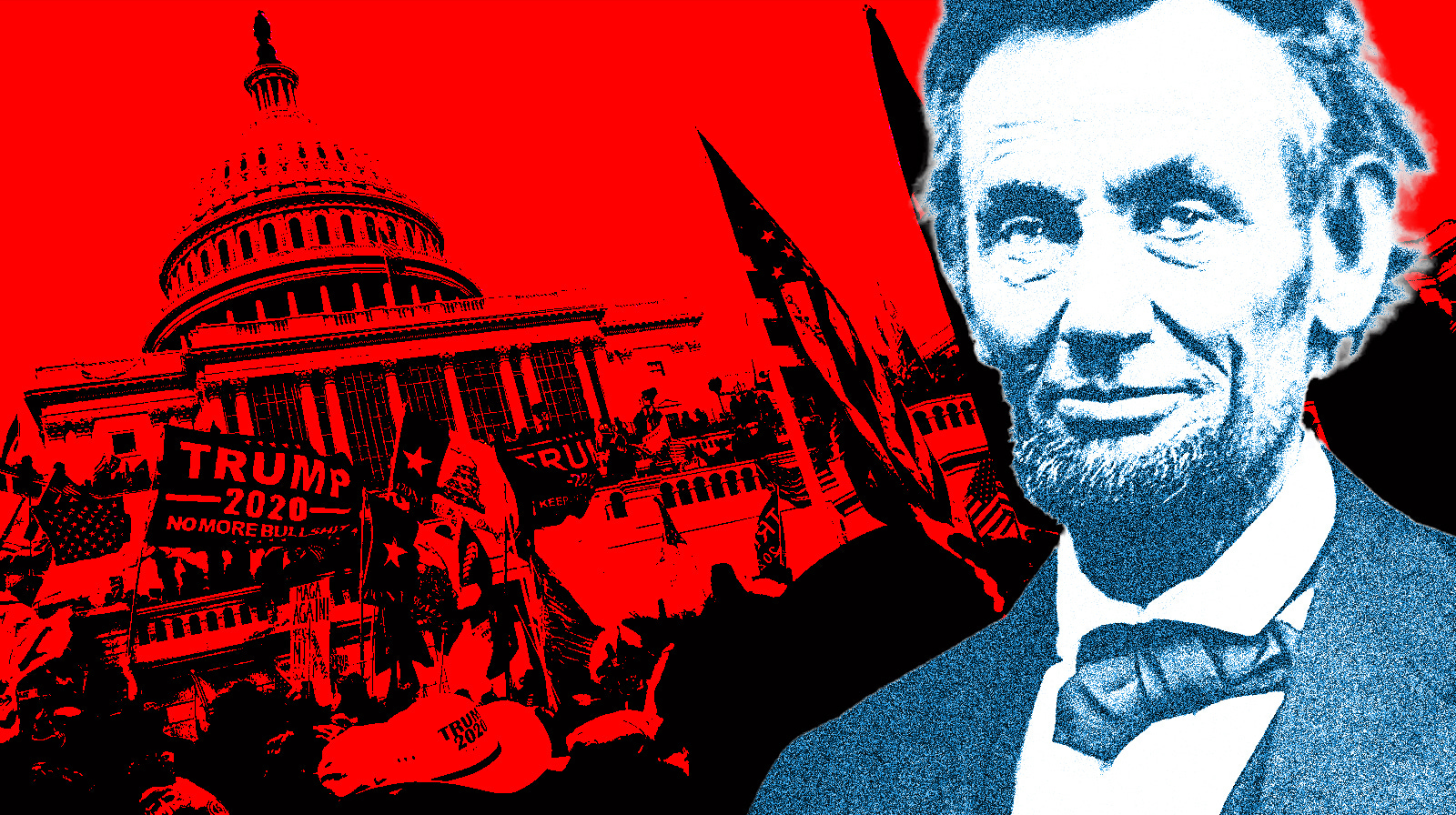
Substitute “Courts” with the federal judiciary Trump has openly defied, and “savage mobs” with the crowd that stormed the Capitol and continues to threaten election officials, and Lincoln sounds less like a historical figure and more like a 2026 dateline dispatch.
His prescription was equally sweeping. Lincoln called for a national “political religion” of law:
“Let every American, every lover of liberty, every well wisher to his posterity, swear by the blood of the Revolution, never to violate in the least particular, the laws of the country; and never to tolerate their violation by others... let it become the political religion of the nation; and let the old and the young, the rich and the poor, the grave and the gay, of all sexes and tongues, and colors and conditions, sacrifice unceasingly upon its altars.”
A movement that wraps itself in the flag while dismantling the legal architecture that flag represents is not patriotic. It is the monster Lincoln warned us about.
⚡Outraged? Turn that energy into action - hit subscribe now and join thousands of other followers.⚡
Violence Dressed as Governance
Lincoln watched similar norm-destruction in real time. The Kansas-Nebraska Act of 1854, which shredded established legal boundaries in the name of “popular sovereignty,” drove him to white-hot precision.
Writing to his friend Joshua Speed in 1855, he called it what it was:
“I look upon that enactment not as a law, but as violence from the beginning. It was conceived in violence, passed in violence, is maintained in violence, and is being executed in violence.”
Lincoln grasped that the constitutional structure posed the central question every generation must answer. Addressing Congress on July 4, 1861, he asked:
“Is there, in all republics, this inherent and fatal weakness? Must a government, of necessity, be too strong for the liberties of its own people, or too weak to maintain its own existence?”
Lincoln answered with his presidency. He acknowledged that extraordinary action might sometimes be necessary to preserve the republic, but held an inviolable line:
“By general law life and limb must be protected; yet often a limb must be amputated to save a life; but a life is never wisely given to save a limb.”
The republic was worth protecting. Destroying the republic to protect the man who runs it inverts the entire bargain.
The Man Who Shapes Belief Shapes Everything
Lincoln’s sharpest diagnostic for 2026 may be his theory of public sentiment. During his 1858 debates with Senator Stephen Douglas, he declared:
“Public sentiment is everything. With public sentiment, nothing can fail; without it nothing can succeed. Consequently he who moulds public sentiment, goes deeper than he who enacts statutes or pronounces decisions. He makes statutes and decisions possible or impossible to be executed.”
Trump has never been a legislator. He is a sentiment-moulder, a grievance engine who grasps intuitively what Lincoln articulated carefully. The difference is that Trump uses this power to destroy the cultural consensus that makes democratic governance viable.
Lincoln’s antidote was reason. His 1842 Temperance Address closed with a vision of democratic culture at its best:
“Happy day, when, all appetites controlled, all poisons subdued, all matter subjected, mind, all conquering mind, shall live and move the monarch of the world. Glorious consummation! Hail fall of Fury! Reign of Reason, all hail!”
Lincoln also understood that conviction without pragmatism collapses. He told supporters he hoped to have God on his side, then added the line every serious coalition-builder knows: “I must have Kentucky.”
Movements that sacrifice winning majorities for ideological purity ultimately serve no one but their opponents.
When God Becomes a Partisan Weapon
The MAGA movement wraps itself in the language of divine mission. Trump’s court evangelicals have spent years proclaiming his presidency a mandate from heaven. Lincoln, who genuinely wrestled with faith and national purpose, would find that claim reckless and historically illiterate.
Writing privately after the Union’s crushing defeat at Second Bull Run in 1862, he reflected:
“The will of God prevails. In great contests each party claims to act in accordance with the will of God. Both may be, and one must be, wrong. God cannot be for and against the same thing at the same time. In the present civil war it is quite possible that God’s purpose is something different from the purpose of either party.”
He offered the same framework to Quaker leader Eliza Gurney:
“We must believe that He permits it for some wise purpose of his own, mysterious and unknown to us... Meanwhile we must work earnestly in the best light He gives us, trusting that with our limited understandings we may still do what appears to be wise and right.”
His Second Inaugural extended this humility to the public stage:
“Both read the same Bible, and pray to the same God; and each invokes His aid against the other... The Almighty has His own purposes.”
Lincoln’s personal conviction was blunt:
“My concern is not whether God is on our side; my greatest concern is to be on God’s side, for God is always right.”
A movement that treats its leader as infallible has no use for that kind of accountability.
The Fiery Trial Has a Destination
History provides the map, even when surviving the journey feels impossible. Lincoln called on every American to return to the founding covenant.
His Peoria Speech of 1854 issued a challenge that still stands:
“Let us re-adopt the Declaration of Independence, and with it, the practices, and policy, which harmonize with it... We shall have so saved it, that the succeeding millions of free happy people, the world over, shall rise up, and call us blessed, to the latest generations.”
Addressing Congress in December 1862, with the war at its bloodiest and the outcome genuinely uncertain, he wrote:
“The dogmas of the quiet past, are inadequate to the stormy present. The occasion is piled high with difficulty, and we must rise, with the occasion. As our case is new, so we must think anew, and act anew. We must disenthrall ourselves, and then we shall save our country... We shall nobly save, or meanly lose, the last best hope of earth.”
That phrase is not rhetoric. It is a verdict history reserves for every generation asked to choose what it is made of.
⭐Join the community and never miss an article.⭐
The Better Angels Are Still Here
Lincoln’s First Inaugural, delivered to a country fracturing before his eyes in March 1861, ended not with a threat but with a plea:
“We are not enemies, but friends. We must not be enemies. Though passion may have strained it must not break our bonds of affection.
The mystic chords of memory, stretching from every battlefield and patriot grave to every living heart and hearthstone all over this broad land, will yet swell the chorus of the Union, when again touched, as surely they will be, by the better angels of our nature.”
When the war ended, Lincoln did not call for retribution. His Second Inaugural charted a different path:
“With malice toward none; with charity for all; with firmness in the right, as God gives us to see the right, let us strive on to finish the work we are in; to bind up the nation’s wounds.”
That is the roadmap. Not painless. Not easy. But survivable. The republic Lincoln saved was cracked, bloodied, and exhausted. It held.
Eighteen months into a second term that has assaulted every democratic institution the founders built, Americans who are frightened and furious should hold onto this: Lincoln’s generation faced something far worse, asked the harder question, and chose to answer it right.
That choice belongs to us now.
⭐Feel free to share this post. My articles are never paywalled.⭐

Featured Image Credit: "2021 storming of the United States Capitol" by Tyler Merbler via Wikimedia Commons, used under CC BY 2.0 / Combined with Lincoln portrait via picryl (Public Domain).
I really enjoyed this essay.
Lincoln may not be perfect, but he knows what's up