


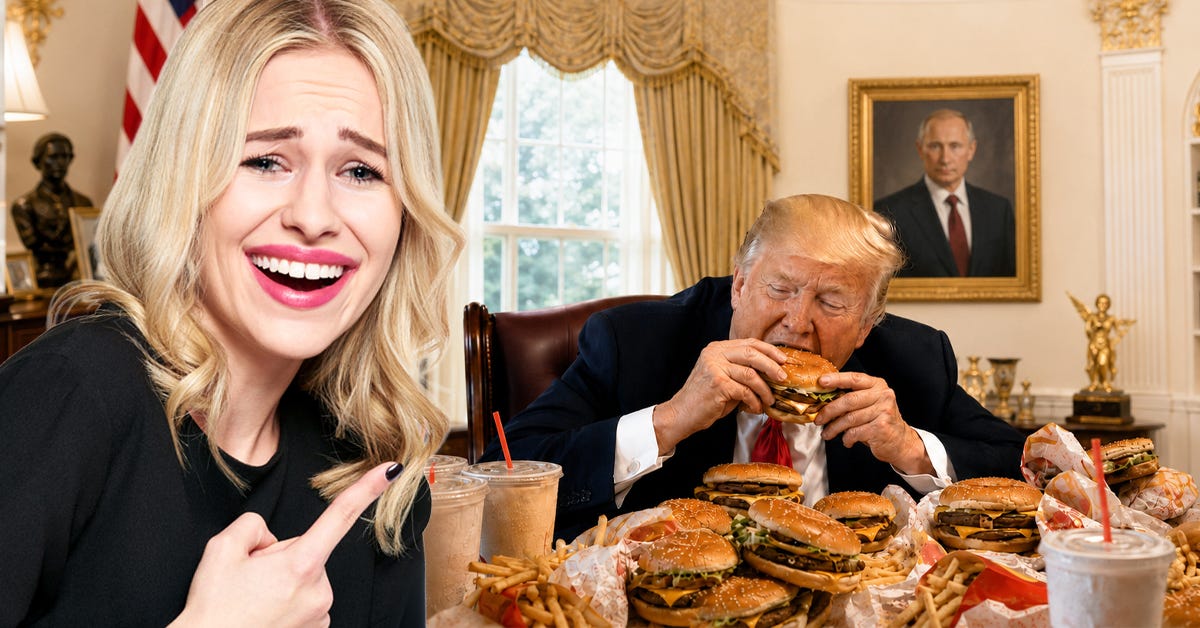
The images flood conservative social media daily: Donald Trump, rendered by artificial intelligence into a barrel-chested action hero, standing atop rubble, cradling assault rifles, biceps competing with tank treads.
MAGA devotees share them like scripture. The captions read “strength,” “fearless,” “built different.” The fantasy requires no facts. It just needs to circulate fast enough to feel real.
The actual Donald Trump spends his days retreating.
He retreats from tariff threats he himself lobbed at trading partners like grenades, only to pull back before the shrapnel could reach his donors’ portfolios.
He retreats from his own policy positions so often that the pattern earned an unofficial name. TACO: Trump Always Chickens Out.
The cycle repeats on loop, a threat, market chaos, a quiet reversal, and then a triumphal press release claiming victory over conditions Trump himself created.
He retreats from the war he started with Iran, signing a memorandum of understanding with Tehran that reads less like a peace deal and more like an unconditional surrender.
This is the would-be strongman's endgame: launch a war of choice, absorb the chaos, then quietly hand the other side what it needs to declare victory so he can move on to his next distraction.
The myth is Superman. The reality is a man who has spent decades perfecting the art of looking powerful while quietly running away.

The TACO Economy: A Study in Capitulation
Trump entered his second term promising the most aggressive trade war in American history. Sixty percent tariffs on Chinese goods. Sweeping levies on European allies. A wall of economic nationalism that would supposedly bring manufacturing jobs flooding back to American soil.
Markets believed him, briefly. Then came the pattern.
The backpedaling started fast. Trump began issuing "pauses," "exemptions," and "reconsiderations" at a pace that left economists whiplashed.
The template became familiar quickly. A threat. Market chaos. A quiet retreat. Then a triumphal press release claiming victory over conditions Trump himself had created.
The most glaring example was a 90-day pause on tariffs for most trading partners. He framed it as strategy. Markets priced it as panic.
Investors started calling his tariff threats "negotiating theater." That is a polite way of saying the emperor keeps forgetting he has no clothes.
His supporters, to their embarrassment had they any shame, barely noticed. The AI images kept coming. The strongman narrative held.
Iran and the Art of the Retreat
The Iran situation deserves its own chapter in the history of Trumpian cowardice dressed as strategy.
Trump spent years painting Iran as an existential threat, ratcheting up sanctions, threatening military strikes, and withdrawing from the 2015 nuclear agreement that had kept Iranian uranium enrichment in check.
The posture was always maximalist, always aggressive, always designed to project dominance.
Then came the negotiations after he entered a War of Choice with Iran.
The Trump administration found itself engaged in indirect talks with Tehran, the same government Trump had called a terrorist regime, the same leadership he had threatened to destroy.
His team framed the talks as leverage. Observers with functioning memories recognized them for what they were: a desperate attempt to avoid a military confrontation that Trump had neither the stomach nor the strategy to win.
The man who promised to be tougher on Iran than any president in history was quietly sitting across a table, hoping Tehran wouldn't notice how hard he was blinking.
He was also hoping MAGA wouldn't grasp the uglier truth. The deal he offered Iran was far worse than Obama's.
His base, meanwhile, was sharing images of him striding toward nuclear mushroom clouds without flinching.
The Myth Requires the Lie
Here is the thing that makes all of this both amusing and genuinely alarming: neither Trump nor his most devoted supporters actually believe the myth.
The AI images exist precisely because the reality is so different. Nobody generates fantasy art of someone who already looks the part.
The worship is compensatory. It is a collective agreement to look away from a man with a documented history of six corporate bankruptcies, a criminal conviction that made him the first American president sentenced as a felony criminal, and a governing record built almost entirely on threats he never follows through on.
The lies are not incidental to Trump’s brand. They are the brand. He’s reportedly made over 30,000 false or misleading statements across his political career.
His supporters do not believe the lies any more than a wrestling fan believes the chair shots are real. They simply prefer the performance to the truth.
The problem is that the rest of us live in the world his retreats and reversals are reshaping.
⭐This publication exists because readers like you show up. Join the community and never miss an article.⭐
The Loser’s Endgame
The cruelest irony of the Trump myth is where it leaves his supporters.
Every TACO moment, every Iran backdown, every policy reversal disguised as a strategic pivot, erodes the very premise on which they cast their vote: the idea that strength at the top translates to strength for the country. It does not.
A president who blinks when markets scream is not protecting American workers. He is protecting American shareholders, the very class of people his supporters were told he would fight against.
The lose-lose calculus sharpens every month. Trump cannot credibly threaten adversaries who have watched him retreat repeatedly. He cannot rally a base trained to ignore contradictions. He cannot rehabilitate a legacy built on myth when the myth keeps collapsing under the weight of real events.
America’s greatest loser has always been hiding in plain sight, spray-tanned and retreating, right behind the myth his followers built to replace him.
⭐Feel free to share this post. My articles are never paywalled.⭐
Why I Will Celebrate the 250th Anniversary of American Democracy After Donald Trump Leaves Office.
America Is Greater Than Any President.
On July 4, 2026, the United States will mark 250 years since the signing of the Declaration of Independence. It is a milestone few nations have ever reached. It represents two and a half centuries of extraordinary achievement, painful failures, remarkable resilience, and the continuing pursuit of a more perfect Union.
Many Americans will celebrate that anniversary with fireworks, parades, concerts, and patriotic speeches. They should.
But I will wait. I will celebrate America’s 250th anniversary after Donald Trump leaves office.
That is not because I love America any less than any other American. It is because I love America too much to pretend that all is well when it is not.
Patriotism is not blind loyalty to a president. Patriotism is loyalty to the Constitution, to democracy, to the rule of law, and to the enduring principle that in America, no one, not even the President, is above the law.
When those principles are once again secure, I will celebrate with joy.
Until then, my task is not celebration. It is citizenship.
trump tells POWER LIES!!
LIES that NO ONE believes but his followers believe trump IS strong because they see that he GETS AWAY with ALL his LIES!!
EVEN the ONES they tell themselves about him!
BUT.. what DECADES of HISTORY have shown us ALL...
trump has NO LOYALTY to ANYONE ELSE EVER!!
NEVER EVER TRUST A BULLY because they are SO insecure narcissistic and paranoid that sooner than later EVERYONE becomes one of their TARGETS!!