


Donald Trump did not just disrupt the global order - he torched it. His administration’s “America First” doctrine ripped the United States out of 66 international organizations, including 31 United Nations bodies.
Trump’s strategy is to replace multilateral cooperation with transactional nationalism, treating allies as freeloaders and international law as an obstacle to American muscle.
The post-World War II order, built by the United States, delivered decades of peace, prosperity, and progress. Trump decided it was expendable.
He sold this demolition as strength, but the result has been chaos, instability, and a world where autocrats feel emboldened. The villain is clear. The consequences are global.

The Call: How We Win This Fight
This is not a time for despair. It is a time for action. Scholars, foreign policy analysts, and democratic reformers have laid out concrete steps readers and institutions can take:
Vote in every electoral cycle. The direction of U.S. foreign policy, and the fate of the global order, depends on it.
Support the Democratic Resilience Pact nations. Back their efforts to reinforce election security and fight disinformation.
Donate to and volunteer with organizations rebuilding multilateral frameworks and defending international law.
Pressure local elected officials to join the Global Cities Compact and advance climate and human rights agendas.
Advocate for the Alliance for Democratic Technology to set global digital rights standards.
Organize like the grassroots movements in Poland and South Korea. Demand that your government maintain sanctions on autocrats and uphold commitments to NATO, the EU, and other alliances.
That agenda matters because the fight is already underway, and the evidence says democratic resistance is stronger than the nihilists want us to believe.
⭐⭐ The Art of Living’s Content is never paywalled, but paid support makes this work possible.⭐⭐
The Evidence: Resistance Is Already Underway
Despair is not the only story. The same studies that map the wreckage also reveal a surge of resistance and renewal. Democratic institutions in allied countries have proven more resilient than anyone expected.
Parliaments and courts in Europe and East Asia have constrained executive overreach and reaffirmed commitments to multilateral norms.
Civil society organizations have stepped up to defend press freedom, minority rights, and electoral integrity, filling the vacuum left by U.S. retreat.
Grassroots movements in Poland, South Korea, and Germany have pressured their governments to maintain sanctions on Russia and uphold NATO and EU commitments, even when leaders wavered.
Last week, Viktor Orbán not only lost his bid for another term, but his successor’s party won a super majority in Hungary’s National Assembly.
A coalition of middle powers - led by Germany, Japan, and Canada - has launched the Democratic Resilience Pact, pooling resources to reinforce election security, counter disinformation, and coordinate sanctions policy independently of Washington.
Legislative resistance is real. Bipartisan coalitions in Congress have blocked or delayed Trump’s attempts to withdraw from key treaties and alliances. Courts in the U.S. and abroad have set new limits on executive authority, especially regarding foreign policy and treaty abrogation.
The European Union has expanded its strategic autonomy, deepening defense cooperation through the Permanent Structured Cooperation framework (PESCO).
Transnational networks of mayors and governors have formed the Global Cities Compact, advancing climate and human rights agendas regardless of national policy reversals.
The Alliance for Democratic Technology is setting global standards for digital rights and fighting authoritarian surveillance exports.
International institutions like the World Health Organization, the International Criminal Court, and the Paris Climate Accord have survived and even thrived under EU, Japanese, and Canadian leadership.
Hal Brands, writing in Foreign Policy, puts it bluntly: “Much remains contingent; much hinges on U.S. decisions and electoral cycles ahead.”
The future is not predetermined. The window for action is open.
The Crossroads: Crisis or Comeback
The world stands at a crossroads, not a dead end. Brands invokes Gramsci: “The old world is dying, and the new world struggles to be born.”
This is not the first time democracy has faced a crisis. The collapse of British hegemony in the early 1900s unleashed decades of chaos, but it also set the stage for a new, more just order.
The lesson is clear: periods of upheaval are also moments of possibility. The current moment feels precarious because every scenario - new Cold War, regional empires, or global anarchy - remains plausible.
But the evidence shows that resistance is not only possible, it is already happening.
Democratic agency is real. Electoral cycles matter. Coalition-building works. Grassroots organizing changes outcomes.
Brands writes, “Exploring what lies beyond our interregnum is the first step in girding for a world that - even in the best-case scenario - will be more fractured and ferocious than the one we’ve left behind.”
Preparation is not surrender. It is the beginning of recovery.
The Strategy: Turning Agency Into Action
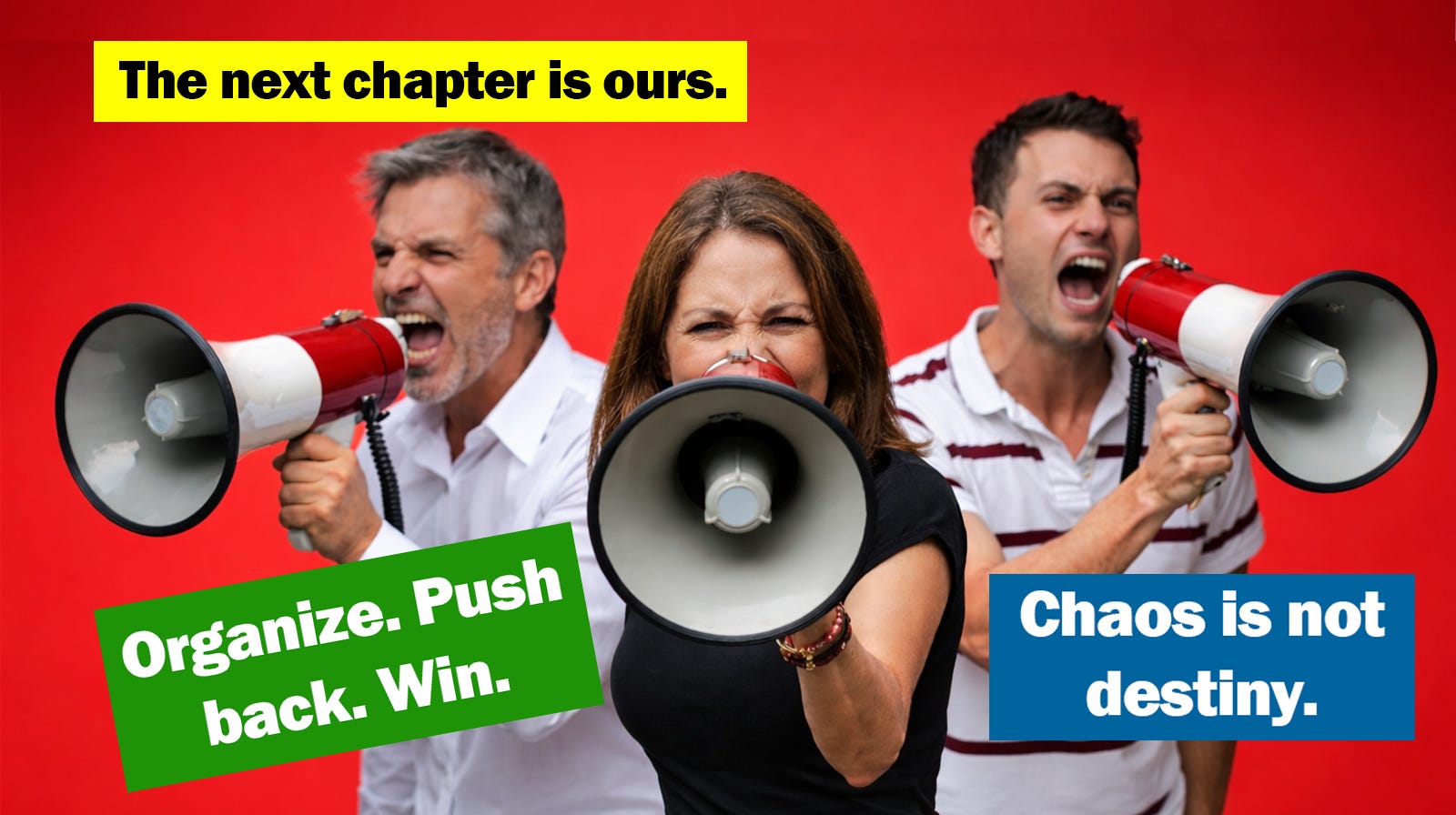
The MAGA movement’s chaos is not destiny. The world’s democracies are not waiting for permission to fight back.
The Democratic Resilience Pact is already reinforcing election security and countering disinformation. The Global Cities Compact is advancing climate and human rights, city by city.
The Alliance for Democratic Technology is setting the rules for a free and open internet.
Grassroots movements in Poland and South Korea have shown that public pressure can force governments to maintain sanctions and uphold international commitments.
Legislative and judicial pushback in the U.S. has blocked some of the worst excesses of Trump’s foreign policy. The EU’s PESCO framework is building a new foundation for collective security.
International institutions have not collapsed. The World Health Organization, the International Criminal Court, and the Paris Climate Accord are still standing, led by coalitions of democracies determined to keep global cooperation alive.
The revitalized G7, now including Australia and South Korea, is coordinating responses to cyber threats and economic coercion.
The Next Chapter
Gramsci’s warning still fits this moment: “The old world is dying, and the new world struggles to be born.”
Brands is just as clear about what comes next: “Much remains contingent; much hinges on U.S. decisions and electoral cycles ahead.”
The outcome is not inevitable. The future is not fixed. The next chapter is ours to write.
⭐⭐ Feel free to share. The Art of Living articles are never paywalled.⭐⭐