


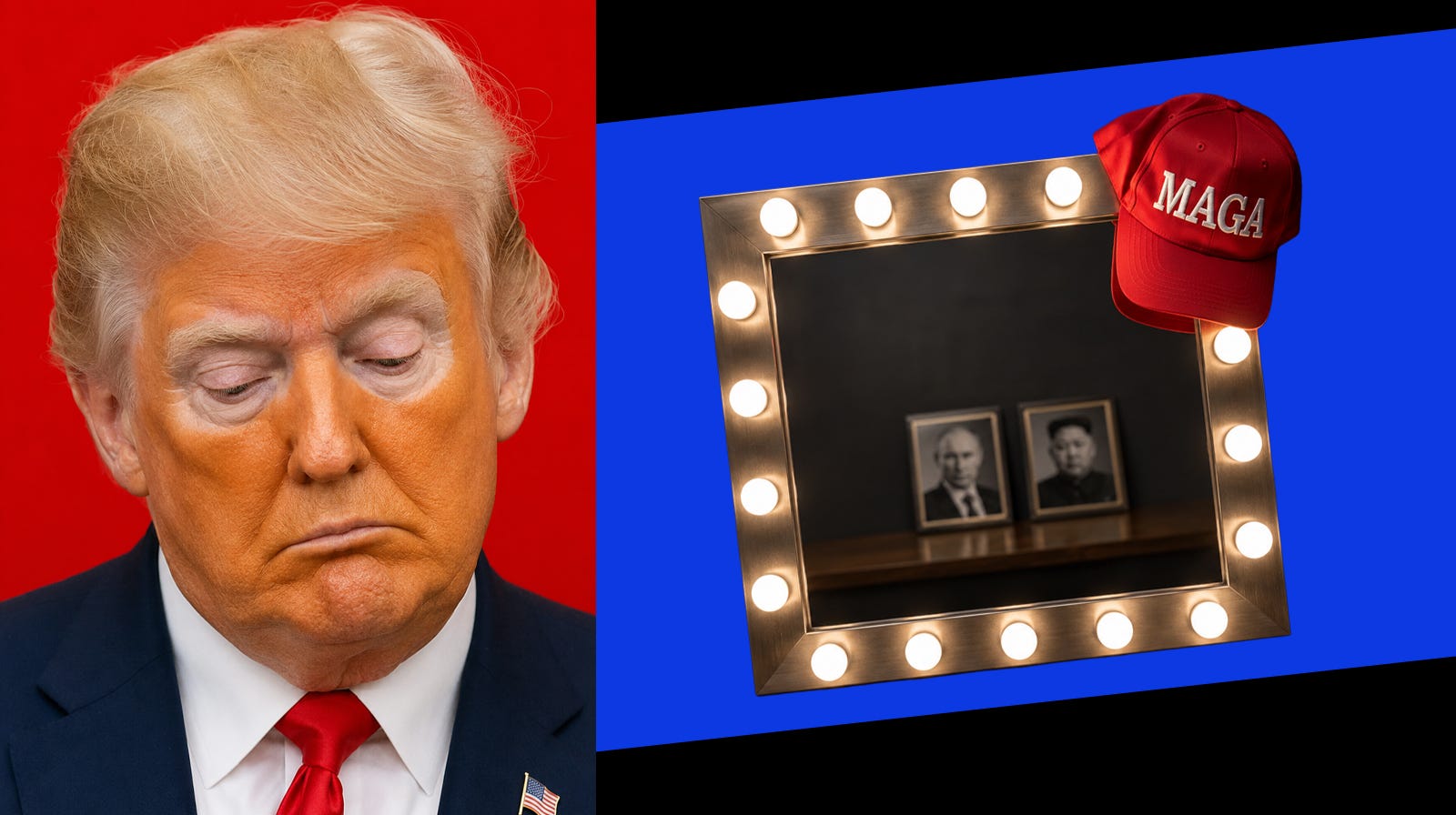
To explore how Donald Trump strategically incorporates elements of femininity, camp, and queerness into his political persona, sociological and gender-studies frameworks must move beyond the basic concept of toxic hypermasculinity.
Instead, his public appeal is best understood through the lens of “hybrid masculinity.”
Under this framework, a dominant group maintains its hegemonic [total social dominance] power and male privilege not by remaining rigidly traditional, but by strategically hybridizing - borrowing performative, aesthetic, and emotional elements from marginalized groups (including women and queer subcultures).
By analyzing Trump’s specific embrace of self-feminization, so-called “mean girl” social media dynamics, staged victimhood, and the carnivalesque, we can map out how this unique gender paradox functions to attract a highly diverse, national audience.

1. The Aesthetics of the “Drag Queen You Can Vote For”
While traditional American leaders have historically projected their masculinity through unadorned, stoic, and rugged physical presentation, Trump’s daily self-fashioning relies heavily on highly stylized, artificial, and historically feminized beauty routines.
Critics and designers have noted that Trump and his inner circle popularize a distinct, homogenized aesthetic often termed the “Mar-a-Lago face.”
Characterized by conspicuous makeup, heavy cosmetic bronzer, pink under-eye circles, platinum-blond hair, and pouty lips, this aesthetic relies on extreme artifice rather than physical verisimilitude.
This visual style is rooted in a camp sensibility. In her seminal 1964 essay Notes on “Camp”, Susan Sontag defined the essence of camp as a “love of the unnatural: of artifice and exaggeration,” representing a “victory of style over content, aesthetics over morality.”
Trump’s physical appearance - combined with his gilded, gold-plated interior design, love of gossip, and history of selling perfume - creates an aesthetic of luxury based on sheer visual intensity and spectacle rather than traditional, understated masculine refinement.
For different segments of his audience, this flamboyant display operates on multiple levels:
For Gay Supporters: Prominent pro-Trump gay figures and groups (such as Gays for Trump) actively recognize and celebrate this aesthetic, affectionately labeling him “the drag queen you can vote for.”
They find his theatricality, “cattiness,” and dramatic flair reminiscent of iconic gay performance traditions - a playful, rebellious spirit they feel has been drained from mainstream, polite politics.
For Cis-Hetero Supporters: The broader public and his straight base generally do not interpret his orange makeup, elaborate hair, or effeminate hand gestures through the lens of gender non-conformity.
Instead, they dismiss these qualities as harmless “eccentric showmanship” or a byproduct of his extensive background as a reality-TV host.
This allows them to consume and enjoy his flamboyant entertainment value without questioning his adherence to heteronormative structures.
2. “Mean Girl” Social Media Dynamics and Teen-Girl Bullying
Trump’s primary mechanism of public attack deviates sharply from the traditional, face-to-face physical confrontation associated with historical strongmen.
Instead, his verbal warfare is highly digital, reputational, and characterized by a style of aggression that cultural critics compare to “mean girl” teenage bullying.
Rather than deploying stoic, silent power, Trump uses platforms like Twitter and Truth Social as a virtual “Burn Book.” He relies on:
High-frequency emotional whining, public complaining, and personal grievances.
Obsessive body-shaming and personal insults targeting his opponents’ appearances (e.g., calling rivals “ugly” or commenting on cosmetic procedures).
Demeanor characterized by “cattiness,” petty social exclusions, and the demanding of absolute, constant praise from his circle.
This self-feminization through gossip and social-media pettiness allows Trump to bypass the rigid, emotionally restricted standards of traditional manhood. By adopting a communicative style historically stereotyped as feminine and adolescent, Trump gains a unique rhetorical shield.
This behavior lowers the bar for public discourse, transforming serious political conflict into highly addictive, low-effort entertainment. It grants him the “license of the entertainer,” enabling him to shrug off the ethical and civic responsibilities expected of a mature male statesman.
⚡Outraged? Turn that energy into action - hit subscribe now and join thousands of other followers.⚡
3. The “Witch Hunt” Paradox: Staging Feminized Victimhood
One of the most complex sociological maneuvers in the Trumpian performance is his constant, strategic adoption of the “witch hunt” metaphor to describe legal investigations and political opposition.
Historically and anthropologically, “witch hunts” represent a brutal, highly gendered form of patriarchal violence designed to suppress, torture, and execute vulnerable, marginalized women who lacked male protection.
When Trump - an incredibly wealthy, powerful, and elite male head of state - invokes this term to shield himself from legal accountability, he engages in a profound rhetorical inversion.
This acts as a political form of DARVO (Deny, Attack, Reverse Victim and Offender):
Self-Feminization and Vulnerability: By framing himself as the helpless prey of a powerful, state-sanctioned “hunt,” Trump temporarily “queers” his gender identity.
He steps out of the dominant, aggressive male role and adopts a highly feminized position of victimhood.
This allows him to tap into deep public sympathy, particularly among followers who also see themselves as victims of modern social and economic change.The “Magical” Sovereign: Crucially, Trump pairs this performance of vulnerable victimhood with assertions of superhuman strength.
He insinuates that, like a literal witch, he possesses magical, subversive powers that place him beyond the capabilities of ordinary humans.
He presents himself as a martyr who suffers this “persecution” solely on behalf of his followers, arguing that his survival of these “hunts” is proof of his ultimate, unyielding power.
By emptying the “witch hunt” metaphor of its historical, gendered meaning, Trump constructs a highly effective, degendered narrative of male persecution that successfully mobilizes grievance-driven populist support.
4. Carnivalesque Populism and the Rites of “Y.M.C.A.”
To understand how these contradictory gender performances are synthesized in public, cultural theorists point to Mikhail Bakhtin’s theory of the “carnivalesque.”
Historically, the medieval carnival was a temporary, festive zone of transgression where established social hierarchies were playfully inverted, taboos were violated, and the “official” voice of authority was subjected to grotesque parody.
Trump’s political rallies operate as a modern, mediatized form of this political carnival. He occupies a dual role as both the powerful ringmaster and the transgressive “fool,” utilizing humor, strategic sacrilege, and mockery to bond with his audience.
The ultimate physical manifestation of this carnivalesque fusion of camp, queerness, and populism is Trump’s co-optation of the Village People's “Y.M.C.A.” to close out his rallies.
The Queer Origin: Released in 1978, the song is a world-famous gay disco anthem celebrating physical, homoerotic spaces and Greenwich Village gay-fantasy personas (the cowboy, the cop, the leather biker).
The Performance: Trump transformed this anthem into a staple of his political brand, developing a highly choreographed, stiff, waist-high fist-pumping dance to the track. At his pre-inauguration rallies, Trump even performed alongside the Village People themselves in their high-camp costumes.
The Paradox of Reception: While mainstream, conservative family audiences consume the song as a wholesome, nostalgic, and patriotic sports anthem, gay supporters recognize the underlying camp and queer play of the performance.
Trump’s use of a French-produced gay disco track - rather than a traditional, hyper-patriotic rock song like Bruce Springsteen’s “Born in the U.S.A.” - demonstrates his profound comfort with aesthetic hybridity and camp theatricality.
Conclusion: The Mechanics of “Fake Subversion”
By combining hyper-aggressive, patriarchal rhetoric with theatrical, flamboyant, and queer aesthetics, Donald Trump achieves what gender theorists call “fake subversion.”
True queer subversion aims to dismantle rigid gender binaries and authoritarian power structures. Trump, however, appropriates the aesthetic of queer rebellion to deliver highly conservative, reactionary content.
He stages an anti-elegant, rule-breaking, and campy gender revolution that promises profound societal upheaval, but does so with the ultimate goal of restoring traditional, heteropatriarchal hierarchies and elite domination.
This unique synthesis allows him to appear “disgusting but authentic” to the masses, utilizing a highly stylized, performative femininity to expand his populist reach far beyond the boundaries of traditional conservative masculinity.
⭐Feel free to share this post. My articles are never paywalled.⭐

Really interesting. But I believe it would be unnecessary mythologizing of Trump to say that his strategy follows a conscious plan or vision. Rather, it is just one more symptom of his fucked up personality that lacks all the normal abilities to see oneself through the eyes of others. In fact, it is not uncommon among very young kids to present mixed gender signals, when the desire to be like both daddy and mom is still possible because of a not yet crystallized identity.
And then there's the reported feminization of his good friend but incapable secretary of defense (war) Pete Hegseth. As a couple reporters wrote good ol' Pete has his own beauty salon in the Pentagon. Queer is as queer does.