


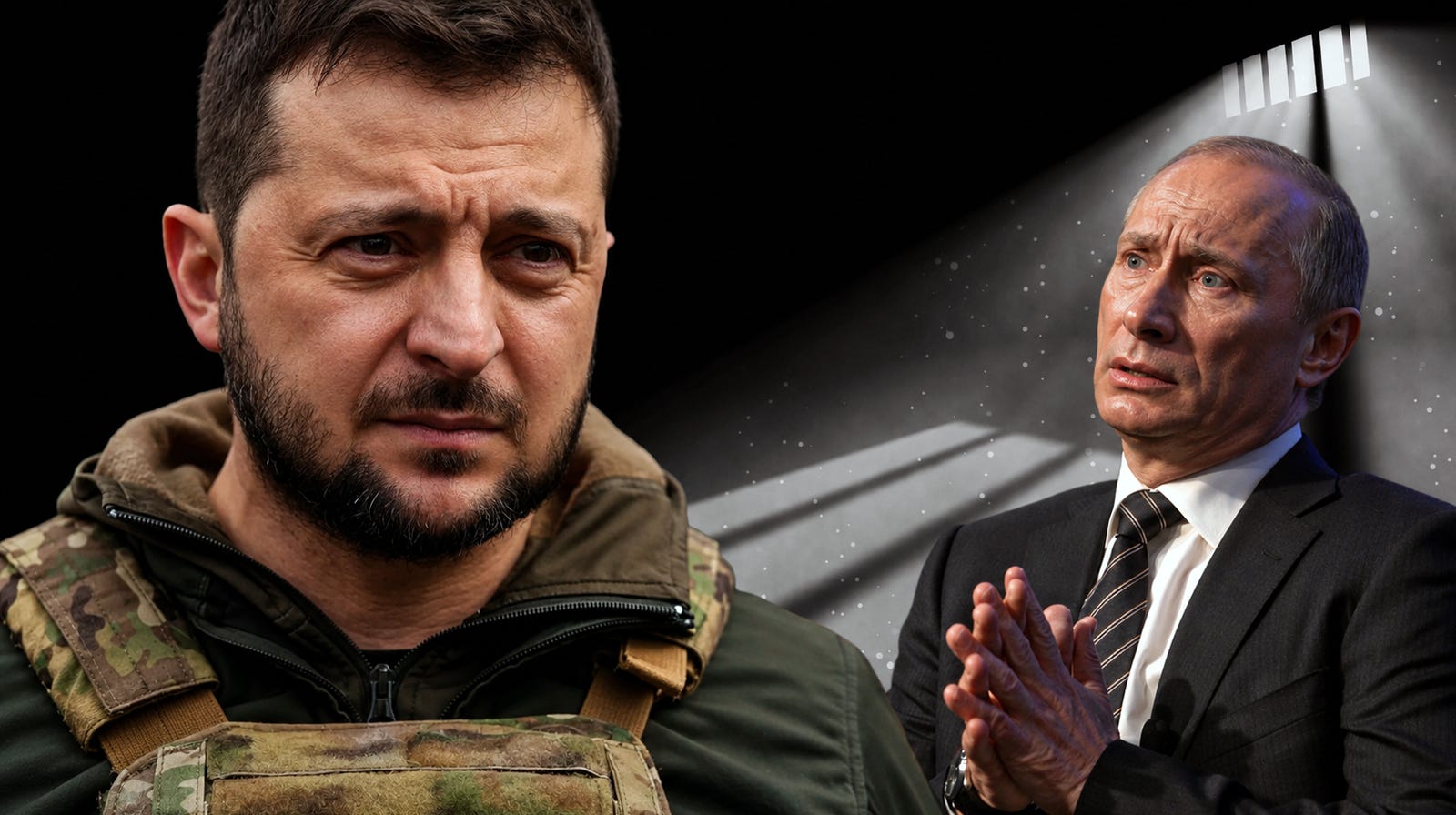
Ukrainian President Volodymyr Zelenskyy delivered a devastating psychological assessment of the Russian regime in a blunt statement released on June 19, 2026.
He bypassed standard diplomatic language to expose a critical vulnerability, stating plainly:
“There’s no doubt that Putin fears the return of his army home. That is why he is so afraid of the war ending without victory. And there will be no victory. He is physically afraid of his own army.”
This deep-seated anxiety represents the primary structural barrier to ending the conflict, transforming a war of territorial aggression into a mathematical calculation for regime survival.
The Kremlin perceives the mass return of a highly militarized, traumatized, and politically volatile force back into civilian society as an immediate threat.
Zelenskyy warned that this panic dictates the Russian leader’s entire long-term strategy, noting that
“[I]f there is no ceasefire backed by specific security guarantees, he will return to war. And this time, others may be the ones under attack.”
A deployed force acts as an instrument of state power, but an idle force returning home directly threatens the stability of the autocracy.

The Illusion of Distance Shatters
This psychological vulnerability is being aggressively exposed by a major tactical shift on the battlefield. Moscow and St. Petersburg remained insulated from the grim realities of the front lines for years. That illusion evaporated entirely in mid-2026.
Ukraine’s long-range drone campaign has matured into a systematic degradation of Russia’s primary energy infrastructure. The structural consequences have brought the war straight to the doorsteps of the Russian elite:
The Kapotnya Strike: Drone attacks on the Kapotnya Oil Refinery - located a mere 15 kilometers from the Kremlin - forced an indefinite shutdown of operations after severely damaging its primary crude processing unit.
The refinery satisfies up to 40% of Moscow’s gasoline demand and 50% of its diesel, triggering localized panic and regional fuel rationing.Airspace Chaos: Air travel at Moscow’s busiest airports was repeatedly suspended, resulting in hundreds of delayed flights and mass passenger evacuations.
Black Oil Rain: The literal sight of thick black smoke rising over Moscow and toxic soot settling on suburban streets shattered any lingering sense of domestic normalcy.
The Modern “Afghan Syndrome”
Zelenskyy’s diagnosis points to a volatile domestic crisis brewing within the Russian Presidential Administration.
Government officials are increasingly preoccupied with a modern equivalent to “Afghan syndrome” - the profound disillusionment and criminalization of Soviet veterans returning from Afghanistan in the late 1980s, which historically fueled the rise of powerful organized crime syndicates.
The demographic scale of this crisis is vastly magnified today. Penal colonies yielded between 120,000 and 180,000 convict recruits who entered the front lines under promises of presidential pardons.
Russian military courts had already documented over 989 cases of murder or grievous bodily harm committed by returning veterans by late 2025.
The Kremlin’s current strategy relies on tight co-optation and preemptive neutralization rather than genuine social integration. Initiatives like the “Time of Heroes” program fast-track veterans into tightly controlled municipal government roles.
However, analysts note these programs deliberately prioritize ordinary, unambitious individuals to prevent the emergence of organic, independent veterans’ groups that could challenge the military top brass.
The memory of Yevgeny Prigozhin’s June 2023 mutiny remains a vivid warning of how quickly disgruntled, armed soldiers can turn their columns toward Moscow.
The Stalinist Template
This anxiety is woven deeply into the historical fabric of Russian autocracy. Joseph Stalin operated under the exact same paradigm at the conclusion of World War II, viewing the returning soldier not as a hero, but as a dangerous vector of ideological contagion and political defiance.
Stalin feared that exposure to Western living standards had contaminated the minds of his troops. Furthermore, having defeated Nazi Germany, returning soldiers held an immense independent moral authority that did not owe its existence purely to state terror.
The state systematically dismantled this collective identity through a network of roughly 100 NKVD and SMERSH filtration camps.
This historical paranoia even birthed the enduring “Valaam Myth” - the widespread urban legend that Stalin ordered disabled, impoverished veterans to be systematically swept off city streets and exiled to a remote archipelago to hide them from public view.
While modern historical research proves the myth is technically false, the story thrived in popular memory precisely because it aligned perfectly with the public’s knowledge of a state that routinely prioritized absolute regime control over human dignity.
😻Subscribe, free or paid, to help keep my unemployed cats fed and my work independent, fearless, and without paywalls.😻
Ukraine’s Upper Hand Leaves Putin with No Exit
Zelenskyy’s assessment highlights the ultimate, recurring vulnerability of the Russian autocracy: the fear of its own armed populace.
He is, in effect, warning the world that Putin will never willingly end the war now that Ukraine clearly holds the upper hand.
Freezing the conflict without a total victory leaves the Russian dictator completely trapped by his own strategic failures.
Negotiating an international ceasefire without airtight, de jure security guarantees like formal NATO integration will fail to stop this cycle.
Driven by a profound fear of domestic demobilization, the Kremlin will inevitably seek new external targets simply to keep its massive military apparatus occupied and pointing outward.
⭐Feel free to share this post. My articles are never paywalled.⭐
Image credit: Zelenskyy image public domain. Putin image adapted from “Vladimir Putin - World Economic Forum Annual Meeting Davos 2009,” photographed by Sebastian Derungs / swiss-image.ch for the World Economic Forum, Davos-Klosters, Switzerland, January 29, 2009. Copyright © World Economic Forum. Licensed under CC BY-NC-SA 4.0. Modified for this featured image, including changes to facial expression and integration into a composite image.
This is super interesting and astute. Fear of returning armies has been a risk or a fear for thousands of years. A real problem for Russia and Putin.
Slava Ukraini!
Although I lived through a lot of the time you referenced, I wasn't aware of the issue of returning solders; thank you for the information.